Dewalt DCB119 - Mode d'emploi
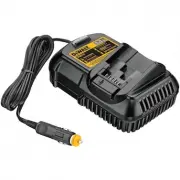
Chargeur Dewalt DCB119 - Mode d'emploi, à lire gratuitement en ligne au format PDF. Nous espérons que cela vous aidera à résoudre toutes les questions que vous pourriez avoir. Si vous avez encore des questions, contactez-nous via le formulaire de contact.

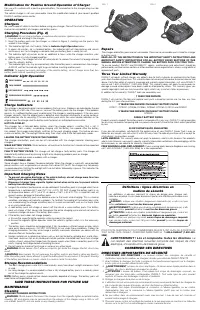
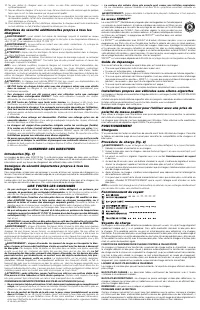
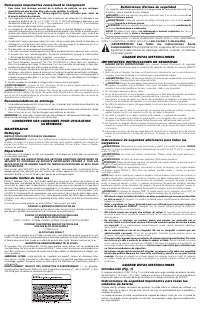
Table des matières:
- Page 2 – AVERTISSEMENT ! Lire et comprendre toutes les directives.
- Page 3 – Installations propres aux véhicules sans allume-cigarettes; FONCTION DE SUSPENSION DE CHARGE CONTRE LE CHAUD/FROID
- Page 4 – El incumplimiento con cualquiera de las instrucciones
Definitions: Safety Guidelines
The definitions below describe the level of severity for each signal word. Please read the
manual and pay attention to these symbols.
DANGER:
Indicates an imminently hazardous situation which, if not avoided,
will
result in
death or serious injury
.
WARNING:
Indicates a potentially hazardous situation which, if not avoided,
could
result in
death or serious injury
.
CAUTION:
Indicates a potentially hazardous situation which, if not avoided,
may
result in
minor or moderate injury
.
NOTICE:
Indicates a practice
not related to personal injury
which, if not avoided,
may
result in
property damage
.
IF YOU HAVE ANY QUESTIONS OR COMMENTS ABOUT THIS OR ANY D
E
WALT TOOL, CALL
US TOLL FREE AT:
1-800-4-D
E
WALT (1-800-433-9258)
.
WARNING! Read and understand all instructions.
Failure to follow
all instructions listed below may result in electric shock, fire and/or
serious personal injury.
SAVE THESE INSTRUCTIONS
IMPORTANT SAFETY INSTRUCTIONS
1.
SAVE THESE INSTRUCTIONS:
This manual contains important safety and operating
instruc tions for the DCB119 D
E
WALT vehicle battery charger.
2. Before using charger, read all instructions and cautionary markings on charger, battery pack
and product using battery pack.
3.
WARNING:
Shock hazard. Do not allow any liquid to get inside the charger. Electric shock
may result.
4.
CAUTION:
Burn hazard. To reduce the risk of injury, charge only D
E
WALT rechargeable
battery packs. Other types of batteries may overheat and burst resulting in personal injury and
property damage.
5. Do not expose charger to rain or snow.
6. Use of an attachment not recommended or sold by the battery charger manufacturer may
result in a risk of fire, electric shock, or injury to persons.
7. To reduce risk of damage to cigarette lighter connector and cord, pull by cigarette lighter
connector rather than cord when disconnecting charger.
8. Do not use in marine (salt water) environments. The salt in sea water is corrosive and can
damage the charger.
9. Make sure that cord is located so that it will not be stepped on, tripped over or otherwise
subjected to damage or stress.
10. Do not operate charger with damaged cord or plug – replace it immediately.
11. Do not operate charger if it has received a sharp blow, been dropped, or otherwise damaged
in any way. Take it to a qualified service person.
12. Do not disassemble charger; take it to a qualified service person when service or repair is
required. Incorrect reassembly may result in a risk of electric shock or fire.
13. To reduce risk of electric shock, unplug charger before attempting any maintenance or
cleaning. Turning off controls will not reduce this risk.
Additional Safety Instructions for All Chargers
WARNING:
To reduce the risk of injury and damage to the battery pack,
NEVER
store or charge
the battery pack below 40°F (4.5°C) or above 105°F (40.5°C).
WARNING:
Do not probe with conductive objects. Electric shock or electrocution may result.
WARNING:
Do not use in explosive atmospheres. Ignition may occur.
CAUTION:
Shock hazard. Do not allow any liquid to get inside charger. Electric shock may result.
CAUTION:
Burn hazard. To reduce the risk of injury, charge only D
E
WALT rechargeable
batteries. Other types of batteries may burst causing personal injury and damage.
NOTICE:
Under certain conditions, with the charger plugged into the power supply, the charger can
be shorted by foreign material. Foreign materials of a conductive nature, such as, but not limited
to, grinding dust, metal chips, steel wool, aluminum foil or any buildup of metallic particles should be
kept away from the charger cavities. Always unplug the charger from the power supply when there
is no battery pack in the cavity. Unplug the charger before attempting to clean.
CAUTION:
The DCB119 vehicle charger is exempt from FCC requirements, however, use
must be discontinued if any type of interference is detected.
•
DO NOT attempt to charge the battery pack with any chargers other than the ones in
this manual.
The charger and battery pack are specifically designed to work together.
•
These chargers are not intended for any uses other than charging D
E
WALT
rechargeable batteries.
Any other uses may result in risk of fire, electric shock or electrocution.
•
DO NOT attempt to use it with any other voltage system.
The charger is designed to
operate from a 12-volt negative ground vehicle battery system.
•
Do not disassemble charger, there are no user serviceable parts; take it to an
authorized service center when service or repair is required.
Incorrect reassembly may
result in a risk of electric shock, electrocution or fire.
•
Use of an extension cord is not recommended. Do not use an extension cord unless
it is absolutely necessary.
Use of improper extension cord could result in risk of fire, electric
shock, or electrocution.
•
The charger plug has an integral overload protector (fuse). If a cord set or plug failure
occurs, a replacement cord set must be used.
This part is available from D
E
WALT certified
service centers at extra cost. DO NOT operate the charger without proper overload protection
(fuse). Refer to
Special Installations for Vehicles Without Cigarette Lighters
.
•
Do not place any object on top of charger or place the charger on a soft surface that
might block the ventilation slots and result in excessive internal heat.
Place the charger
in a position away from any heat source. The charger is ventilated through slots in the top and
the bottom of the housing.
SAVE THESE INSTRUCTIONS
Introduction (Fig. 1)
The DCB119 battery charger (Fig. 1) is designed to charge D
E
WALT 12V Max* and 20V Max*
lithium-ion battery packs. Refer to the chart at the end of this manual for information on the charge
times of various D
E
WALT battery packs.
These chargers require no adjustment and are designed to be as easy as possible to operate.
Simply place your battery pack into a receptacle of a plugged in charger and it will automatically
charge the pack. Consult the chart at the end of this manual for compatibility of chargers and battery
packs.
Important Safety Instructions for All Battery Packs
When ordering replacement battery packs, be sure to include the catalog number and voltage.
Consult the chart at the end of this manual for compatibility of chargers and battery packs.
The battery pack is not fully charged out of the carton. Before using the battery pack and charger,
read the safety instructions below and then follow charging procedures outlined.
READ ALL INSTRUCTIONS
• Do not charge or use the battery pack in explosive atmospheres, such as in the presence of
flammable liquids, gases or dust. Inserting or removing the battery pack from the charger may
ignite the dust or fumes.
• Never force the battery pack into the charger. Do not modify the battery pack in any
way to fit into a non-compatible charger as battery pack may rupture causing serious
personal injury.
Consult the chart at the end of this manual for compatibility of batteries and
chargers.
• Charge the battery packs only in designated D
E
WALT chargers.
•
DO NOT
splash or immerse in water or other liquids.
• Do not store or use the tool and battery pack in locations where the temperature may
reach or exceed 105°F (40°C) (such as outside sheds or metal buildings in summer).
For best life store battery packs in a cool, dry location.
NOTE: Do not store the battery packs in a tool with the trigger switch locked on. Never
tape the trigger switch in the ON position.
WARNING:
Fire hazard. Never attempt to open the battery pack for any reason. If the battery
pack case is cracked or damaged, do not insert into the charger. Do not crush, drop or damage
the battery pack. Do not use a battery pack or charger that has received a sharp blow, been
dropped, run over or damaged in any way (e.g., pierced with a nail, hit with a hammer, stepped
on). Damaged battery packs should be returned to the service center for recycling.
WARNING:
Fire hazard. Do not store or carry the battery pack so that metal objects
can contact exposed battery terminals.
For example, do not place the battery pack in
aprons, pockets, tool boxes, product kit boxes, drawers, etc., with loose nails, screws, keys, etc.
Transporting batteries can possibly cause fires if the battery terminals inadvertently
come in contact with conductive materials such as keys, coins, hand tools and the like.
The US Department of Transportation Hazardous Material Regulations (HMR) actually prohibit
transporting batteries in commerce or on airplanes (e.g., packed in suitcases and carry-on luggage)
UNLESS they are properly protected from short circuits. So when transporting individual battery
packs, make sure that the battery terminals are protected and well insulated from materials that
could contact them and cause a short circuit.
CAUTION: When not in use, place tool on its side on a stable surface where it will not
cause a tripping or falling hazard.
Some tools with large battery packs will stand upright on the
battery pack but may be easily knocked over.
SPECIFIC SAFETY INSTRUCTIONS FOR LITHIUM ION (Li-Ion)
•
Do not incinerate the battery pack even if it is severely damaged or is completely
worn out.
The battery pack can explode in a fire. Toxic fumes and materials are created when
lithium ion battery packs are burned.
•
If battery contents come into contact with the skin, immediately wash area with mild
soap and water.
If battery liquid gets into the eye, rinse water over the open eye for 15 minutes
or until irritation ceases. If medical attention is needed, the battery electrolyte is composed of a
mixture of liquid organic carbonates and lithium salts.
•
Contents of opened battery cells may cause respiratory irritation.
Provide fresh air. If
symptoms persist, seek medical attention.
WARNING:
Burn hazard. Battery liquid may be flammable if exposed to spark or flame.
The RBRC™ Seal
The RBRC™ (Rechargeable Battery Recycling Corp
oration) Seal on the nickel
cadmium, nickel metal hydride or lithium ion batteries (or battery packs) indicate that
the costs to recycle these batteries (or battery packs) at the end of their useful life
have already been paid by D
E
WALT. In some areas, it is illegal to place spent nickel
cadmium, nickel metal hydride or lithium ion batteries in the trash or municipal solid
waste stream and the RBRC™ program provides an environmentally conscious
alternative.
RBRC™, in cooperation with D
E
WALT and other battery users, has established programs in the
United States and Canada to facilitate the collection of spent nickel cadmium, nickel metal hydride
or lithium ion batteries. Help protect our environment and conserve natural resources by returning
the spent nickel cadmium, nickel metal hydride or lithium ion batteries to an authorized D
E
WALT
service center or to your local retailer for recycling. You may also contact your local recycling center
for information on where to drop off the spent battery.
RBRC™ is a registered trademark of the
Rechargeable Battery Recycling Corporation.
Troubleshooting
If the indicator light does not come on when the battery pack is inserted into the charger:
• Be sure the battery pack is inserted in the proper direction;
• Try a second pack if one is available;
• Be sure the charger plug is fully inserted into the cigarette lighter socket;
• Be sure the cigarette lighter socket is not connected to the ignition switch, so that power is
disconnected in the “OFF” position; ensure the ignition switch is in the accessories position and
the cigarette lighter operates;
• Be sure the cigarette lighter socket is clean;
• Be sure the cigarette lighter operates in the socket.
Special Installations for Vehicles Without Cigarette Lighters
The charger has an integral overload protector (fuse). DO NOT REMOVE THIS PLUG.
Purchase a female cigarette lighter receptacle from your local automotive parts store. Wire this
receptacle in accordance with the instructions provided with the cigarette lighter receptacle.
Plug your charger into this receptacle.
D
E
WALT Industrial Tool Co., 701 East Joppa Road, Baltimore, MD 21286
(OCT11) Part No. N143776 DCB119 Copyright © 2011 D
E
WALT
The following are trademarks for one or more D
E
WALT power tools: the yellow and black color scheme,
the “D” shaped air intake grill, the array of pyramids on the handgrip, the kit box configuration, and the
array of lozenge-shaped humps on the surface of the tool.
INSTRUCTION MANUAL
GUIDE D’UTILISATION
MANUAL DE INSTRUCCIONES
INSTRUCTIVO DE OPERACIÓN, CENTROS DE SERVICIO Y PÓLIZA
DE GARANTÍA.
ADVERTENCIA:
LÉASE ESTE INSTRUCTIVO
ANTES DE USAR EL PRODUCTO.
If you have questions or comments, contact us.
Pour toute question ou tout commentaire, nous contacter.
Si tiene dudas o comentarios, contáctenos.
1-800-4-D
E
WALT • www.D
E
WALT.com
DCB119 Li-Ion Vehicle Charger
Chargeur pour véhicule DCB119 Li-Ion
DCB119 Cargador en vehículo Li-Ion
« Chargement du manuel » signifie que vous devez attendre que le fichier soit complètement chargé avant de pouvoir le lire en ligne. Certains manuels sont très volumineux, et le temps de chargement dépend de la vitesse de votre connexion Internet.
Ce manuel vous a-t-il été utile ?
À propos de ce manuel
- Marque
- Dewalt
- Modèle
- DCB119
- Type de document
- Mode d'emploi
- Catégorie
- Chargeur
- Langue(s)
- Espagnol, Français
- Pages
- 4
- Taille du fichier
- 1,8 MB
- Format
Résumé
Modification for Positive Ground Operation of Charger For use with a vehicle with a positive ground battery, the connection to the charger plug must be reversed.The vehicle charger is not user serviceable. Have this modification made at your nearest qualified D E WALT certified service center. OPERA...
10. Ne pas utiliser le chargeur avec un cordon ou une fiche endommagé ; les changer systématiquement. 11. Ne pas utiliser le chargeur s’il a reçu un coup, fait une chute ou a été endommagé de quelque façon que ce soit. Le faire examiner par du personnel qualifié. 12. Ne pas démonter le chargeur. Po...
Remarques importantes concernant le chargement 1. Pour éviter tout drainage excessif de la batterie du véhicule, ne pas recharger simultanément plus de deux blocs-piles sans réutiliser le véhicule. 2. Déconnectez le chargeur de l’allume-cigarettes après utilisation pour éviter de drainer la batterie...
Poser une question
Manuels associés
Plus de modèles chargeurs Dewalt

Autres appareils Dewalt
 Mode d'emploi Dewalt 340
 Notice Dewalt 657054-00
 Notice Dewalt Compound Miter Saw
 Mode d'emploi Dewalt Cordless Drill
 Mode d'emploi Dewalt D24000
 Mode d'emploi Dewalt D24001
 Mode d'emploi Dewalt D25012
 Mode d'emploi Dewalt D25012K TYPE1
 Notice Dewalt D25023
 Notice Dewalt D25103
 Notice Dewalt D25201
- Notice Dewalt D25203
 Mode d'emploi Dewalt D25263K
- Notice Dewalt D25303
 Mode d'emploi Dewalt D25304
 Mode d'emploi Dewalt D25313
 Mode d'emploi Dewalt D25324
 Mode d'emploi Dewalt D25333K
 Notice Dewalt D25333K QS